In this article, I will feature one healthcare stock that has seen intensive insider selling during the last 30 days. Intensive insider selling can be defined by the following three criteria:
- The stock was sold by three or more insiders within one month.
- The stock was not purchased by any insiders in the month of intensive selling.
- At least two sellers decreased their holdings by more than 10%.
C. R. Bard (BCR) designs, manufactures, packages, distributes, and sells medical, surgical, diagnostic, and patient care devices worldwide.
(click to enlarge)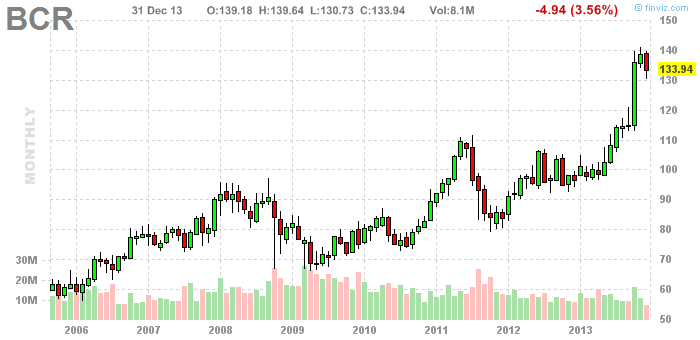
Insider selling during the last 30 days
Here is a table of C. R. Bard's insider-trading activity during the last 30 days by insider.
| Name | Title | Trade Date | Shares Sold | Rule 10b5-1 | Current Ownership | Decrease In Ownership |
| Timothy Ring | CEO | Dec 2-23 | 34,167 | Yes | 196,242 shares | 14.8% |
| Jim Beasley | Group President | Dec 12-16 | 33,428 | Yes | 42,569 shares + 17,312 options | 35.8% |
| Timothy Collins | Group President | Dec 16 | 3,347 | Yes | 48,790 shares | 6.4% |
| John Deford | SVP | Dec 12 | 2,792 | Yes | 33,555 shares + 16,643 options | 5.3% |
| John Weiland | COO | Dec 10 | 10,389 | Yes | 129,567 shares | 7.4% |
There have been 84,123 shares sold by insiders during the last 30 days. All these shares were sold pursuant to a Rule 10b5-1 plan.
SEC Rule 10b5-1 is a regulation enacted by the United States Securities and Exchange Commission (SEC) in 2000. The SEC states that Rule 10b5-1 was enacted in order to resolve an unsettled issue over the definition of insider trading, which is prohibited by SEC Rule 10b-5. After Rule 10b5-1 was enacted, the SEC staff publicly took the position that canceling a planned trade made under the safe harbor does not constitute insider trading, even if the person was aware of the inside information when canceling the trade. This staff interpretation raises the possibility that executives can exploit this safe harbor by entering into 10b5-1 trading plans before they have inside information while retaining the option to later cancel those plans based on inside information.
For example, a CEO of a company could call a broker on January 1 and enter into a plan to sell a particular quantity of shares of his company's stock on March 1, find out terrible news about his company on February 1 that will not become public until April 1, and then go forward with the March 1 sale anyway, saving himself from losing money when the bad news becomes public. Under the terms of Rule 10b5-1(b) this is insider trading because the CEO "was aware" of the inside information when he made the trade. But he can assert an affirmative defense under Rule 10b5-1(c), because he planned the trade before he learned the inside information.
In general, it is a safer way for an insider to sell shares pursuant to a Rule 10b5-1 trading plan than without it.
Insider selling by calendar month
Here is a table of C. R. Bard's insider-trading activity by calendar month.
| Month | Insider selling / shares | Insider buying / shares |
| December 2013 | 84,123 | 0 |
| November 2013 | 22,960 | 0 |
| October 2013 | 262,455 | 0 |
| September 2013 | 46,908 | 0 |
| August 2013 | 62,812 | 0 |
| July 2013 | 159,965 | 0 |
| June 2013 | 22,881 | 0 |
| May 2013 | 19,024 | 0 |
| April 2013 | 763,240 | 0 |
| March 2013 | 685,248 | 0 |
| February 2013 | 22,061 | 0 |
| January 2013 | 3,314 | 0 |
There have been 2,154,991 shares sold, and there have been zero shares purchased by insiders this year.
Financials
C. R. Bard reported the third-quarter financial results on October 22 with the following highlights:
| Revenue | $758.0 million |
| Net income | $93.2 million |
| Cash | $781.7 million |
| Debt | $1.5 billion |
Outlook
C. R. Bard's guidance is as follows:
| Q4/2013 | FY2013 | |
| Sales growth | 1-3% | 2-5% |
| Adjusted EPS | $1.34-$1.39 | $5.70-$5.75 |
(click to enlarge)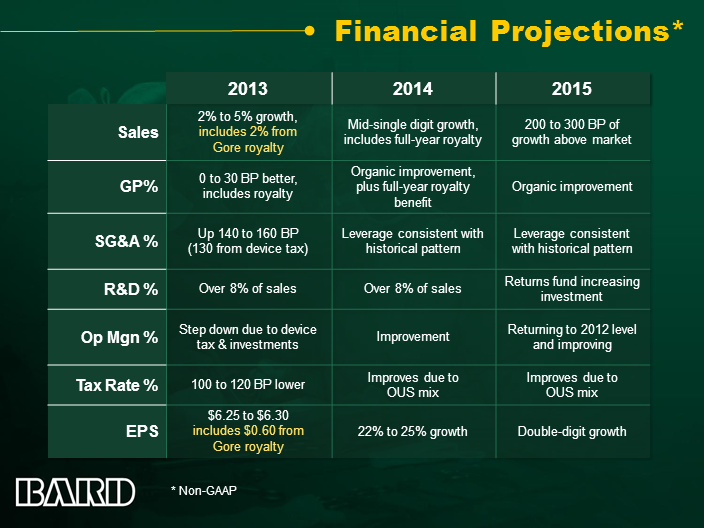
(Source: November presentation)
Competition
C. R. Bard's competitors include Boston Scientific (BSX), and Johnson & Johnson (JNJ). Here is a table comparing these companies.
|
C. R. Bard has the second-highest P/S ratio among these three companies.
Here is a table of these competitors' insider-trading activities this year.
| Company | Insider buying / shares | Insider selling / shares |
| BSX | 30,000 | 1,591,833 |
| JNJ | 0 | 113,709 |
Only C. R. Bard has seen intensive insider selling during the last 30 days.
Conclusion
There have been five different insiders selling C. R. Bard, and there have not been any insiders buying C. R. Bard during the last 30 days. Two of these five insiders decreased their holdings by more than 10%. C. R. Bard has an insider ownership of 0.90%.
Before entering short C. R. Bard, I would like to get a bearish confirmation from the Point and Figure chart. The two main reasons for the proposed short entry are relatively high P/S ratio, and the intensive insider-selling activity.
Disclosure: I have no positions in any stocks mentioned, and no plans to initiate any positions within the next 72 hours. I wrote this article myself, and it expresses my own opinions. I am not receiving compensation for it (other than from Seeking Alpha). I have no business relationship with any company whose stock is mentioned in this article. (More...)
This entry passed through the Full-Text RSS service — if this is your content and you're reading it on someone else's site, please read the FAQ at fivefilters.org/content-only/faq.php#publishers.

Aucun commentaire:
Enregistrer un commentaire